
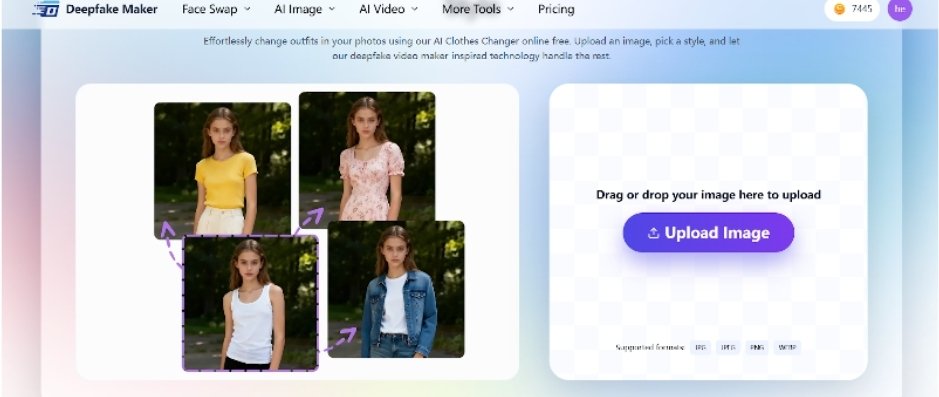
When you need fresh outfit content but don’t have time for a shoot, a deepfake maker AI clothes changer can feel like a cheat code. Upload one clear photo, switch styles, and export a new look in minutes—no closet chaos, no retouching marathon. That’s why creators, marketers, and small fashion teams are quietly building “virtual wardrobe” workflows around tools like Deepfake Maker.
This guide shows how to get results that look believable (not pasted-on), how to choose the right photo, and how to use a deepfake maker AI clothes changer for real projects—social posts, ads, lookbooks, and virtual try-ons—while keeping things ethical and on-brand.
Table of Contents
- What a deepfake maker AI clothes changer actually does
- Why Deepfake Maker’s workflow is built for speed
- Step-by-step: how to use the deepfake maker AI clothes changer
- How to make outfit swaps look real (the realism checklist)
- High-impact use cases (creators, brands, and teams)
- How it compares to other AI clothes changer tools
- Responsible use: consent, rights, and brand safety
- FAQ: deepfake maker AI clothes changer questions
- Final take + next step
What a deepfake maker AI clothes changer actually does
A deepfake maker AI clothes changer is a browser tool that replaces the clothing region in a photo while trying to keep the person’s identity, pose, lighting, and overall scene consistent. Instead of manually masking and compositing garments like a traditional editor, the model “repaints” outfit details—fabric, folds, shadows—so the result reads like a real photo, not a sticker.
The best results come from tools that understand body shape + lighting context, and apply clothing with realistic texture and fit. Deepfake Maker positions its clothes changer as “deepfake video maker-inspired” (i.e., video-grade realism applied to still images), which is essentially the promise: smoother blending, fewer weird edges, and less “AI shimmer.”
Why Deepfake Maker’s workflow is built for speed
Most people don’t fail with a deepfake maker AI clothes changer because the AI is “bad.” They fail because the workflow is annoying: logins, downloads, confusing sliders, or results that take forever.
Deepfake Maker keeps the loop simple:
- Upload → generate → download in three steps
- Common image formats supported (JPG/JPEG/PNG/WEBP)
- The page emphasizes no sign-up / no downloads for getting started
- It also claims private processing where sessions are temporary and images aren’t stored/shared
If you’re building content at scale (Reels + ads + product thumbnails), that “fast loop” matters as much as the model quality.
Step-by-step: how to use the deepfake maker AI clothes changer
Here’s a practical flow you can copy/paste into your own process. This is the deepfake maker AI clothes changer workflow in “real human” terms, plus tweaks that improve output.
Step 1: Start with the right photo
Deepfake Maker recommends high-quality, clear, well-lit, front-facing photos for best results.
What that means in practice:
- Avoid heavy motion blur, low light, and extreme angles
- Choose a photo where your outfit is visible (not fully covered by hair, bags, or props)
- If possible, pick a neutral background (busy backgrounds can confuse edges)
Step 2: Upload and let the AI generate the outfit
Deepfake Maker describes the AI as analyzing your photo and applying a selected outfit with realistic fit and detail.
Two pro tips:
- Iterate: treat generation like a photoshoot—run multiple tries and keep the best
- Be specific (if style/prompt options exist): “black tailored blazer, satin lapels, studio lighting” beats “cool outfit”
Step 3: Download, then do a “quality pass”
Deepfake Maker’s flow ends with download & share.
Before you post:
- Zoom in on collar/neckline edges, wrists, and waistline (common failure zones)
- Check shadow direction and contrast consistency
- If something looks off, do one more run instead of forcing it in a heavy editor
Deepfake Maker’s FAQ also notes processing is typically fast—“less than 30 seconds” on average—which makes iteration realistic for daily content.
How to make outfit swaps look real (the realism checklist)
If you only remember one section, make it this one. A deepfake maker AI clothes changer can produce great output, but you need to feed it the right conditions.
Lighting and pose consistency
Believability is mostly physics:
- If the original photo is soft daylight, don’t expect a glossy latex look to feel natural
- Front-facing + relaxed arms usually works better than extreme poses
The “edge triangle”: hairline, neckline, hands
These three areas decide whether people feel the edit:
- Hairline: hair overlaps clothing—AI can struggle if hair covers shoulders
- Neckline: watch for warped necklaces, collars, or skin-to-fabric seams
- Hands: sleeves often break around wrists; pick photos where wrists are visible and clean
Fabric realism
Deepfake Maker claims clothes “adjust lighting and texture” to match the photo and fit body shape naturally.
To push realism:
- Use materials that match the photo’s sharpness (cotton/denim reads easier than intricate lace)
- Avoid tiny patterns when your base image is low-res
Style variety without chaos
Deepfake Maker highlights a “huge variety of clothing styles,” from formal wear to street fashion (and more).
The trick is to keep a consistent “wardrobe logic”:
- For brand content: keep a tight palette (2–3 colors)
- For creator content: keep a signature silhouette (e.g., oversized hoodie + cargos)
High-impact use cases for a deepfake maker AI clothes changer
Deepfake Maker lists common use cases like fashion visualization, virtual try-on, and social media creation.
Here are upgraded, more “production-ready” ways to use a deepfake maker AI clothes changer.
A) Creator content: weekly outfit refresh without reshoots
If you post daily, outfit repetition quietly hurts performance. A deepfake maker AI clothes changer lets you:
- Keep the same pose/scene (brand consistency)
- Swap outfits to signal “newness” to scrolling users
- Build a recognizable style series (e.g., “Monday office fit,” “Friday street fit”)
B) E-commerce concept testing (even before samples arrive)
For small brands, sample delays are brutal. With a deepfake maker AI clothes changer, you can mock:
- Colorways (black vs beige vs navy)
- Styling (casual vs formal)
- Campaign direction (minimal studio vs lifestyle vibe)
Use it to decide what to shoot for real—then invest your budget on the winning direction.
C) Marketing variations for ads (A/B testing fast)
Ad teams don’t just need one image—they need ten:
- Different outfits for different audiences
- Different moods (sporty vs luxury)
- Seasonal variants (summer linen vs winter coat)
A deepfake maker AI clothes changer turns one base photo into a variation set quickly, and Deepfake Maker’s “upload → generate → download” flow supports that rapid loop.
D) Team headshots and event promos (tasteful, on-brand)
Not everyone loves being photographed. You can keep the same headshot and apply:
- A consistent “conference look”
- Uniform-like outfits for staff pages
- Region-specific styling for localized campaigns
E) Character and concept art reference (for designers)
Illustrators and concept artists often need fast clothing reference. Deepfake Maker even includes a testimonial-style quote about using the tool for character design references.
The benefit: you can explore layers (jacket over knit over shirt) quickly and move back to drawing.
How it compares to other AI clothes changer tools
The market is crowded: you’ll see AI clothes changers from creators’ apps and media tools like AirBrush, Media.io, ImagineArt, and DRESSX-style experiences.
When comparing a deepfake maker AI clothes changer to alternatives, use these filters:
Speed + iteration
Deepfake Maker claims average processing under ~30 seconds, which makes “generate 5 options, pick 1” feasible.
Privacy posture
Deepfake Maker states images aren’t stored/shared and sessions are automatically deleted after processing.
If you’re handling client photos or internal product shots, that claim matters.
Format support and ease
Deepfake Maker supports common web image formats (JPG/JPEG/PNG/WEBP) and runs in-browser.
Style range vs “same-y outputs”
Some tools lean heavily on presets. Deepfake Maker explicitly emphasizes broad style variety (formal to street, etc.).
The best tool is the one that fits your content style—not necessarily the one with the longest feature list.
Bottom line: If your priority is a straightforward, browser-based loop with privacy claims and quick turnaround, the deepfake maker AI clothes changer positioning from Deepfake Maker is aligned with that need.
Responsible use: consent, rights, and brand safety
A deepfake maker AI clothes changer should be used like any image editor—only with:
- Consent from the person in the photo
- Rights to use the image commercially if it’s for ads/products
- Clear avoidance of deceptive or harmful impersonation
If you’re publishing results, consider a light disclosure like “digitally styled” for brand trust—especially in commercial campaigns.
FAQ: deepfake maker AI clothes changer questions
Is the deepfake maker AI clothes changer free to use?
Deepfake Maker’s page states the AI clothes changer is offered “online free” with no hidden fees for basic functions.
How long does a deepfake maker AI clothes changer take per image?
Deepfake Maker’s FAQ says it typically takes less than 30 seconds on average to process and apply an outfit.
Can I use the deepfake maker AI clothes changer on mobile?
Deepfake Maker says it’s optimized for both desktop and mobile browsers.
Will my photos be saved?
Deepfake Maker states images are not stored/shared and sessions are automatically deleted after processing.
What photos work best with a deepfake maker AI clothes changer?
Use clear, well-lit, front-facing photos with minimal blur—this is also the guidance shown in Deepfake Maker’s usage steps.
How do I avoid “fake-looking” results?
Use the realism checklist: clean neckline, visible wrists, consistent lighting, and run multiple generations. The fastest way to win is to iterate—especially when generation is quick.
Final take + next step
If you’re trying to ship more visuals without expanding your shoot budget, the deepfake maker AI clothes changer approach is one of the most practical upgrades you can make this year. It’s not about replacing photography—it’s about speeding up ideation, testing, and variation.
If you want to build a repeatable workflow, start simple:
- Pick one strong base photo
- Generate 5 outfit variations with the deepfake maker AI clothes changer
- Keep the best 1–2, then standardize your style rules (palette + silhouette)
And when you’re ready, use Deepfake Maker as the hub—so outfit swaps, edits, and other creative steps stay in one place.